
BGaming’s Plinko turns the familiar pegboard game into a quick online casino experience: choose a stake, set the risk and number of rows, then watch a ball bounce towards a prize slot. Its simple presentation is easy to understand, but the result of each round is determined by chance. For players in the United Kingdom, the important question is not only whether the game is entertaining, but whether it is available through a properly licensed operator and played with sensible safeguards.
What Is BGaming Plinko?
Plinko is a digital adaptation of a game-show-style board. A ball drops from the top and ricochets off rows of pegs before landing in one of the pockets at the bottom. Each pocket corresponds to a multiplier, so the payout depends on the stake and where the ball finishes. BGaming’s version presents this process in a compact format, with controls for adjusting the round before the drop.
The game is designed for short sessions. There are no long story sequences or complex bonus rounds to learn, and the central action is visible on screen. That straightforward format can make Plinko appealing to people who want a quick game. It can also make it easy to play more rounds than intended, so setting a time and spending limit beforehand matters.
How a Round Works
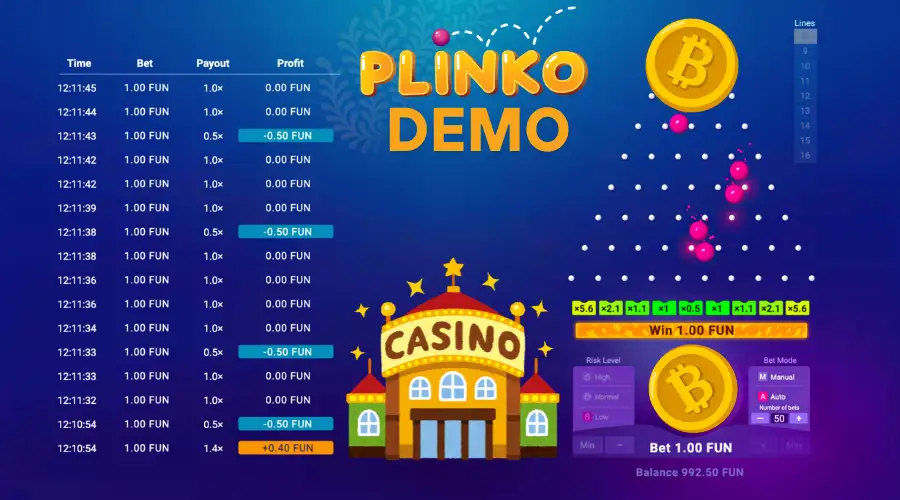
- Choose a stake: Select the amount you are comfortable risking for a single ball.
- Set the board: Where available, choose the number of rows and a risk setting. These options affect the distribution of possible multipliers.
- Drop the ball: Start the round and let the ball travel through the pegs.
- Check the result: The pocket it lands in determines the multiplier applied to the stake, subject to the game’s displayed rules.
More rows generally create a wider spread of possible outcomes, while risk settings can change how frequently smaller or larger multipliers appear. The exact configuration and payout figures can vary by version, so check the in-game information panel rather than relying on figures from another website. A larger top multiplier does not mean a greater chance of receiving it.
Is BGaming Plinko Legitimate for UK Players?
BGaming is a game developer, not the casino operator that takes deposits or pays withdrawals. Whether a UK player can legally access a particular Plinko game depends on the operator, its licence and the applicable rules. The safest approach is to check the casino directly with the UK Gambling Commission’s public register and confirm that the licence covers the business providing the gambling service.
A game’s presence on a website is not, by itself, proof that the site is authorised to serve customers in Great Britain. Avoid operators that are unclear about their ownership, licence, terms, payment processing or complaint route; Do not use a VPN or provide inaccurate details to get around location restrictions. If a casino does not accept customers in your jurisdiction, choose a licensed alternative rather than attempting to bypass its controls.
Checks to Make Before Playing
- Search the operator’s legal name on the UK Gambling Commission register and check for a current licence.
- Read the casino’s terms, including withdrawal conditions, identity checks and any bonus restrictions.
- Look for clear responsible-gambling tools, such as deposit limits, time-outs and self-exclusion.
- Open the game’s help or rules section to review its stake range, settings and payout information.
- Use the casino’s official support channel if the game, account or payment terms are unclear.
These checks do not guarantee a winning session. They help you assess whether the service is accountable and whether you understand the conditions before depositing. A legitimate operator can still offer a game in which a player loses money; licensing is about regulation and consumer protections, not a promise of profit.
Gameplay and User Experience
The main strength of BGaming Plinko is its accessibility. The board communicates the basic idea immediately, and most decisions happen before the ball is released. Players who prefer a quick interface may appreciate being able to select a stake and configuration without navigating a complicated bonus system. The bouncing animation supplies the drama, while the final pocket makes the outcome easy to identify.
That simplicity has limits. Plinko does not offer much strategic depth, and choosing a different risk level does not let a player control the ball’s path. The animation may make each drop feel personal, but the outcome remains random. A series of near misses is not evidence that a larger win is due, and previous results cannot reliably predict the next one.
Risk, Multipliers and Expectations
Risk settings are best understood as ways to change the shape of potential results, not as a method of improving the underlying odds. A configuration with more volatile outcomes may produce frequent modest returns alongside occasional larger multipliers. A lower-volatility option may have a different pattern, but neither setting removes the possibility of losing the stake.
Before playing, review any published return-to-player information and the game’s rules. An RTP figure, when supplied, is a long-term theoretical measure across many plays; it does not forecast what will happen in one session. Likewise, a displayed maximum multiplier describes a possible result, not a likely one. Treat the stake as entertainment spending and never use borrowed money or funds needed for bills.
Practical Tips for a Safer Session
- Set limits first: Decide on a deposit or loss limit and a time limit before opening the game.
- Keep stakes consistent: Do not increase a stake to recover losses or because a win seems overdue.
- Take breaks: Stop if you feel rushed, frustrated or tempted to continue beyond your plan.
- Skip bonus pressure: Read wagering terms carefully; a promotion is not free money if its conditions do not suit you.
- Use available controls: UK-licensed operators should provide safer-gambling tools. Consider a time-out or self-exclusion if gambling is becoming difficult to manage.
These are safeguards, not winning strategies. No staking pattern can guarantee a profit in a game of chance. If gambling is causing harm, stop and seek support. In the UK, GamCare provides confidential help through the National Gambling Helpline, and the National Gambling Support Network can connect people with services in their area.
What to Expect from the Casino
The casino experience matters as much as the game. Check whether the operator explains how to verify an account, what documents may be requested and how long withdrawals typically take. Read payment rules before depositing, especially if you plan to use a particular method. Keep records of transactions and support conversations, and contact the operator through the details published on its site if something goes wrong.
When comparing licensed casinos, focus on transparency rather than flashy promotions. A clear complaints process, accessible safer-gambling settings and straightforward terms are more useful indicators of a responsible service than claims of “easy wins.” Do not assume that every casino carrying BGaming titles has the same licence, policies or customer support standards.
Verdict
BGaming Plinko is a simple, fast-moving game built around a familiar pegboard concept. Its main appeal is the easy-to-follow format and the choice of board settings; its main limitation is that the player cannot steer the ball or turn a setting into a reliable advantage. The possibility of large multipliers should be viewed alongside the chance of losing a stake, not as a prediction of what a session will deliver.
For UK players, “legitimate” depends chiefly on using an appropriately licensed operator and checking the game’s rules and protections. Verify the casino on the UK Gambling Commission register, avoid attempts to bypass restrictions and set firm limits before playing. With those checks in place, Plinko may suit someone looking for brief, chance-based entertainment—but it should never be treated as a way to earn money.
Anyone who chooses to play should make a pachinko-style game fund addition only within a pre-set entertainment budget, and only after checking the operator’s terms. Keep that budget separate from essential expenses, and stop when the limit is reached.